How a Pile of Old Oil Drums Turned Into America's Favorite Weekend Ritual
How a Pile of Old Oil Drums Turned Into America's Favorite Weekend Ritual
Fire up the grill. Grab the tongs. Put on the playlist. For tens of millions of American households, this sequence is as familiar as anything in daily life — a warm-weather ritual that feels permanent, almost elemental, like it's been part of the national identity forever.
It hasn't. The backyard barbecue as Americans know it today is a surprisingly recent invention, and the chain of events that produced it has almost nothing to do with food. It starts with a war, moves through a housing shortage, passes through a factory yard full of repurposed steel barrels, and ends up in the suburban backyard of the 1950s.
Trace it back far enough and the story gets genuinely strange.
The Older Tradition Underneath the Modern One
Before the postwar backyard grill became an American icon, barbecue had a long and deeply rooted history — just not the one most people picture.
The word barbecue itself almost certainly derives from barbacoa, a term used by Indigenous peoples of the Caribbean and the American South to describe a method of slow-cooking meat over low, indirect heat. Spanish explorers encountered the technique in the sixteenth century and brought descriptions of it back to Europe. The method spread and evolved as it moved through different regions and cultures.
In the American South, barbecue developed into a rich regional tradition with distinct local variations — pulled pork in the Carolinas, brisket in Texas, mutton in Kentucky. For much of American history, barbecue was a communal event: a pit dug in the ground, whole animals cooked slowly over coals, large gatherings that could last an entire day. It was not a quick weeknight dinner. It was an occasion.
This version of barbecue remained largely regional and largely tied to specific communities — particularly African American pitmasters in the South, whose techniques and knowledge formed the backbone of the tradition. The individualized, equipment-focused backyard version that most Americans associate with the word today came much later, and from a very different direction.
The War Changed Everything
World War II disrupted nearly every aspect of American domestic life, and its effects on food culture were no exception. Rationing limited what families could cook and how. Manufacturing capacity was redirected toward the war effort. Consumer goods of all kinds became scarce.
But it was the postwar period — specifically the years between 1945 and 1955 — that set the conditions for the backyard barbecue revolution.
When soldiers came home, they came home in enormous numbers, and they needed somewhere to live. The federal government, through programs like the GI Bill, made low-cost mortgages widely available to veterans, fueling an explosion in suburban homebuilding. Developers like William Levitt famously mass-produced entire communities — Levittown in New York, Levittown in Pennsylvania — constructing thousands of modest single-family homes on what had recently been farmland.
These new homes had something in common: a backyard. Not a farm, not a porch, not a shared courtyard — a private outdoor space that belonged to the family and could be used however they wanted. For a generation of Americans who had spent years in cramped military barracks or crowded urban apartments, that backyard was a revelation.
All it needed was something to cook on.
The Oil Drum That Started It All
Here's where the story takes its most unexpected turn.
During and after the war, American industry had produced enormous quantities of steel drums — large cylindrical barrels used to transport oil, chemicals, and other industrial materials. As the war wound down, these drums became surplus. They were cheap, widely available, and made of heavy-gauge steel that could withstand serious heat.
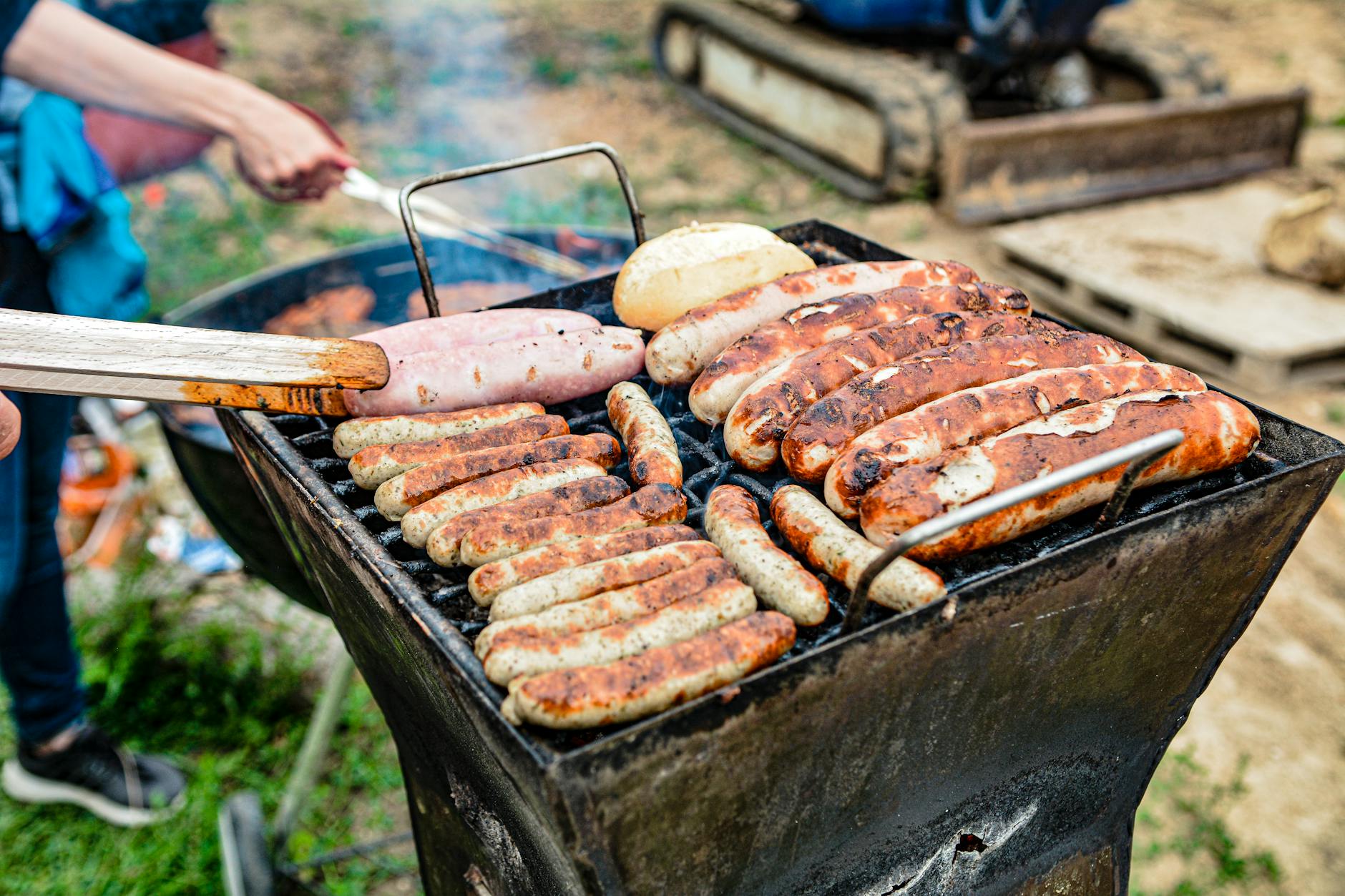
Factory workers and backyard tinkerers across the country began cutting them in half lengthwise, welding on legs, attaching a grate, and using them as outdoor grills. The halved oil drum grill — crude, improvised, and surprisingly effective — became a fixture in working-class neighborhoods and factory yards throughout the late 1940s.
This wasn't a corporate invention or a product launch. It was a grassroots adaptation, the kind of practical problem-solving that happens when people have materials, skills, and a need. The oil drum grill spread through informal networks — neighbors showing neighbors, workers bringing the idea home from the factory floor.
The Briquette That Made It Easy
The other piece of the puzzle was charcoal. Specifically, the standardized charcoal briquette that made outdoor grilling accessible to people without the skill or patience to manage a wood fire.
Charcoal briquettes had actually been around since the 1920s — Henry Ford had developed a process for making them from wood scraps produced at his auto manufacturing plants, eventually spinning the operation into what became the Kingsford Company. But for years, briquettes remained a niche product without a mass market.
The postwar suburban boom created that market almost overnight. Suddenly there were millions of households with backyards, improvised grills, and a desire to cook outdoors on weekends. Kingsford and its competitors were ready. Affordable, consistent, easy-to-light charcoal briquettes turned outdoor grilling from a skill into a weekend hobby.
Retailers noticed. Hardware stores began stocking grills. Manufacturers started producing purpose-built versions of the oil drum design, cleaned up and sold as consumer products. In 1952, a welder named George Stephen cut a buoy mold in half at the Weber Brothers Metal Works near Chicago and created the original kettle grill — a design so effective that it's still in production today.
From Backyard Experiment to National Identity
By the mid-1950s, the pieces had fully assembled. Suburbs full of backyards. Affordable grills. Easy charcoal. A postwar culture that celebrated home ownership, leisure, and the pleasures of private domestic life. Advertisers recognized the moment and leaned into it hard, selling the backyard barbecue as the embodiment of the American good life.
Cookbook authors followed. Magazines ran grilling features through every summer issue. The outdoor cookout became a fixture of July Fourth celebrations, Memorial Day weekends, and neighborhood gatherings across the country.
The Southern tradition that had inspired the name was largely absorbed, simplified, and rebranded. The slow-smoked, pitmaster-driven barbecue of the South didn't disappear — it remained alive and continued to evolve — but it became one strand within a much broader cultural phenomenon that now carried the same name.
The Grill in the Garage
Today, roughly two-thirds of American households own a grill or smoker. The outdoor cooking industry generates billions of dollars annually. Memorial Day weekend alone accounts for a staggering volume of charcoal and propane sales.
None of that was planned. No single inventor designed the American barbecue culture. It assembled itself from a world war, a housing policy, a pile of surplus industrial steel, and the ingenuity of workers who looked at an oil drum and saw a grill.
The next time you're standing in the backyard with a pair of tongs, waiting for the coals to come up to temperature, that's the chain of events you're standing at the end of. It's a longer, stranger story than the smell of charcoal smoke tends to suggest.