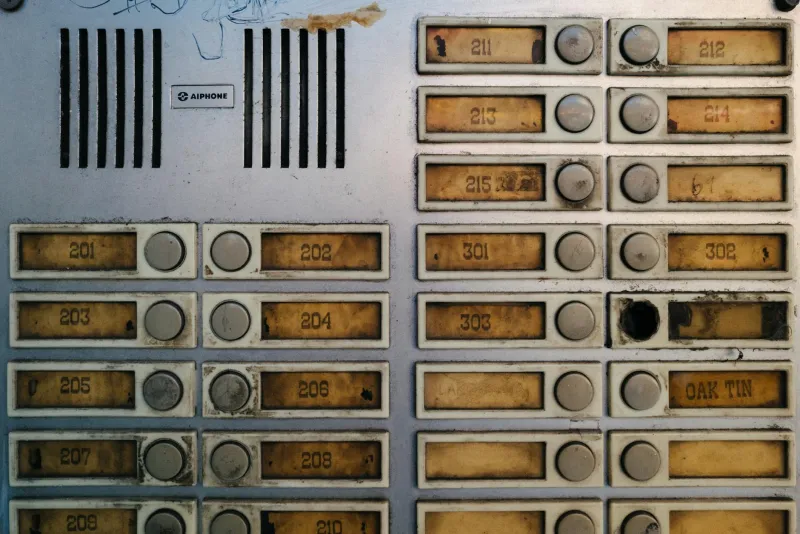
The Sound of Home
Every day, across America, the same familiar melody plays out millions of times: ding-dong. It's so automatic we barely register it, yet this simple two-tone sequence represents one of the most successful accidental inventions in domestic history.
Before 1831, announcing your arrival at someone's home was a messy affair. You knocked loudly, shouted from the street, or yanked on elaborate mechanical contraptions that rang bells somewhere deep inside the house. The wealthy might have had servants to answer doors, but most Americans simply hollered until someone heard them.
Then Joseph Henry, a Scottish-born physicist working in Albany, New York, made a discovery that would change everything—though he had no idea at the time.
 Photo: Albany, New York, via thumbs.dreamstime.com
 Photo: Joseph Henry, via d3ec1vt3scx7rr.cloudfront.net
The Experiment That Went Wrong (But Right)
Henry was obsessed with electromagnetism, the cutting-edge science of his era. In 1831, he was trying to build a more efficient telegraph system, experimenting with ways to send electrical signals across longer distances. His workshop was cluttered with copper wire, magnets, and batteries as he tested different configurations.
During one particularly frustrating session, Henry connected his electromagnetic apparatus incorrectly. Instead of sending a signal down a wire, the electrical current activated a small hammer that struck a bell. The sound was clear, immediate, and unmistakably different from anything people were used to hearing in their homes.
Henry initially saw this as a failure—his telegraph wasn't supposed to ring bells, it was supposed to transmit messages. But something about that crisp, mechanical chime stuck with him.
From Laboratory Curiosity to Household Revolution
It took nearly two decades for Henry's accidental discovery to reach American front doors. The first electric doorbells appeared in the 1850s, installed primarily in wealthy urban homes that already had basic electrical systems. These early versions were simple: press a button, complete a circuit, ring a bell.
But the real breakthrough came in the 1870s when inventors figured out how to create that distinctive two-tone sound. By using electromagnets of different sizes, they could produce a higher note when the button was pressed (ding) and a lower note when it was released (dong). This wasn't just pleasant to hear—it was functionally superior because the two tones made it impossible to confuse a doorbell with other household sounds.
Rewiring American Architecture
The electric doorbell didn't just change how people announced themselves—it fundamentally altered American home design. Before doorbells, front doors needed to be positioned where residents could easily hear visitors. Homes were built with entryways close to main living areas, and families spent most of their time in rooms adjacent to the street.
Once every home could be instantly alerted to visitors, architects gained incredible freedom. Kitchens could move to the back of houses. Living rooms could be positioned for privacy rather than door-monitoring duty. Families could spread throughout their homes without worrying about missing guests.
By the 1920s, the doorbell had become so central to American domestic life that real estate developers used it as a selling point. "Electric doorbell installed" appeared in countless property advertisements, right alongside "running water" and "electric lighting."
The Etiquette Revolution
Doorbells also quietly rewrote the rules of American social interaction. Before electric chimes, visiting someone required either prior arrangement or the awkward process of standing outside their home making noise until they noticed you. Surprise visits were genuinely surprising because they involved such obvious disruption.
The doorbell made drop-in visits socially acceptable. You could announce yourself politely, wait for acknowledgment, and proceed only if welcomed. This created the modern concept of the "front door conversation"—brief interactions where hosts could greet visitors without necessarily inviting them inside.
Salespeople, in particular, revolutionized their approach once doorbells became standard. Door-to-door sales exploded in the mid-20th century precisely because the doorbell made initial contact so much more civilized.
Why America Chose Ding-Dong
Interestingly, the two-tone doorbell sound isn't universal. British doorbells often use longer, more elaborate chimes. Many European countries prefer single-tone buzzes or mechanical clanking sounds. But Americans overwhelmingly settled on the simple ding-dong pattern.
This choice reflected broader American preferences for efficiency and standardization. The two-tone system was easy to install, universally recognizable, and loud enough to hear throughout increasingly large suburban homes. As American houses grew bigger in the post-war boom, the ding-dong doorbell proved perfectly suited to the sprawling ranch homes and split-levels that defined suburbia.
The Digital Age Doorbell
Today, the doorbell is experiencing another revolution. Smart doorbells with cameras, internet connectivity, and smartphone alerts are becoming standard in American homes. Yet even these high-tech versions typically default to that same two-tone chime Henry accidentally discovered in 1831.
Some things change, some things don't. Joseph Henry's failed telegraph experiment continues to announce millions of daily arrivals, proving that the best innovations often come from the most unexpected places. Every time you hear that familiar ding-dong, you're experiencing the echo of a 19th-century laboratory accident that quietly reshaped how America lives.