The Government Reject That Stocked America's Snack Aisle
The Government Reject That Stocked America's Snack Aisle
Picture a warehouse in 1945. The war is winding down. Inside, stacked on pallets from floor to ceiling, sits thousands of pounds of food that the United States military has officially decided it doesn't want. Soldiers rejected it. Procurement officers wrote it off. And yet, somehow, that unwanted surplus didn't rot. It evolved — into something Americans now reach for without a second thought, dozens of times a week.
The story of how rejected military rations became the foundation of America's snack industry is not a tidy one. It doesn't have a single inventor or a famous eureka moment. It has something stranger: a slow, almost accidental drift from government warehouse to grocery store shelf, driven by surplus economics, creative salesmanship, and a civilian population that had spent years being told to make do with less.
Built for Soldiers, Rejected by Soldiers
During World War II, the U.S. military poured enormous resources into solving one of the oldest problems in warfare: how do you feed soldiers efficiently, cheaply, and without refrigeration? The result was a generation of shelf-stable, calorie-dense foods engineered more for survival than pleasure. Some of them worked brilliantly. Others were, by most accounts, genuinely awful.
Among the less beloved inventions were early iterations of compressed, processed snack products — dense, portable, high-calorie items designed to be carried in a pack and eaten on the move. On paper, they were perfect. In practice, soldiers hated them. Complaints rolled in about taste, texture, and the deeply demoralizing experience of eating something that resembled food without actually tasting like it.
Military brass listened. Contracts were canceled. Production lines that had been humming along in food processing plants across the Midwest suddenly went quiet. And the companies that had built those lines were left holding both the equipment and the intellectual property — with no buyer in sight.
The Surplus Problem Nobody Planned For
What happened next is a case study in accidental reinvention. Food manufacturers, many of them small regional operations that had pivoted to wartime contracts, found themselves in a bind. They had production capacity, shelf-stable formulas, and packaging technology that had never existed before the war. What they didn't have was a market.
So they improvised. Some began quietly reformulating those military-grade products — adjusting salt levels, adding flavoring, reworking textures — and testing them on civilian palates. The goal wasn't to launch a snack empire. It was simply to move inventory and keep the lights on.
Grocery distributors, many of whom were already navigating the postwar shift from rationing back to open retail, were willing to take a chance. Shelf space was being renegotiated across the country as supermarkets replaced corner stores and the idea of a dedicated snack section — something that barely existed before the war — began to take shape.
When Cheap Became Convenient
The timing couldn't have been better, even if nobody planned it that way. American life in the late 1940s and early 1950s was accelerating. Returning veterans were buying houses in the suburbs, commuting longer distances, and working in environments where a sit-down lunch wasn't always possible. Their wives were navigating households with less domestic help than previous generations. Everybody was busy, and everybody was hungry in a new, on-the-go kind of way.
The shelf-stable snack products that manufacturers had repurposed from military surplus fit neatly into this new rhythm. They were cheap. They didn't need refrigeration. They came in individual portions. And crucially, they were already there — already manufactured, already packaged, already sitting in distribution networks that stretched coast to coast.
Marketing followed the product, not the other way around. Companies didn't create demand through advertising and then build a product to meet it. They had a product nobody asked for and found a population whose lifestyle had quietly shifted to need exactly that thing.
The Category That Built Itself
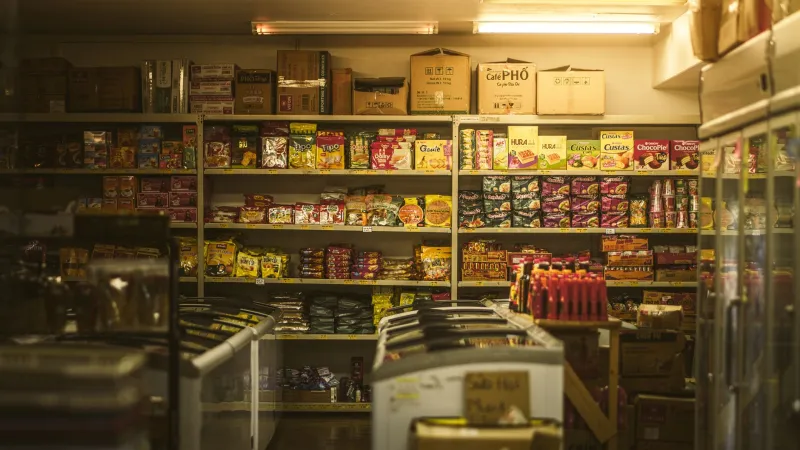
By the mid-1950s, what had started as a salvage operation had become something recognizable: an actual industry. Potato chips, corn-based snacks, compressed crackers, and a growing range of salty, portable, shelf-stable foods were claiming dedicated real estate in supermarkets from New Jersey to California. The snack aisle, as a physical and commercial concept, was crystallizing.
What's remarkable is how little of this was intentional design. The flavors, the formats, the portion sizes — many of them trace back directly to the constraints of military ration development, where calorie density and shelf life mattered far more than culinary ambition. The slight excess of salt that makes a chip so hard to put down? That was originally a preservation technique. The satisfying crunch? A byproduct of industrial drying processes developed to make food survive in a pack for weeks.
Nobody sat down and designed the American snack aisle. It was assembled, piece by piece, from the leftovers of a war effort that ended before anyone could figure out what to do with what it had built.
What's Still in Your Pantry
Today, the American snack food industry generates well over $100 billion annually. It employs hundreds of thousands of people. It has its own trade associations, its own marketing science, its own seasonal product cycles. It is, by any measure, a mature and dominant sector of the food economy.
And almost none of it was supposed to exist.
The next time you tear open a bag of chips at 10 p.m. without really thinking about it, consider that the thing in your hand is the distant descendant of a product a soldier somewhere in the Pacific Theater spat out and refused to finish. It traveled from rejection to reinvention to ubiquity through a chain of accidents, compromises, and economic necessity that nobody fully controlled.
 Photo: Pacific Theater, via www.historyonthenet.com
That's not unusual in American food history. It's practically the rule. The most ordinary things on your shelf tend to have the most extraordinary — and unplanned — backstories.