The Greeting Card Exists Because Victorians Were Terrible at Talking About Death
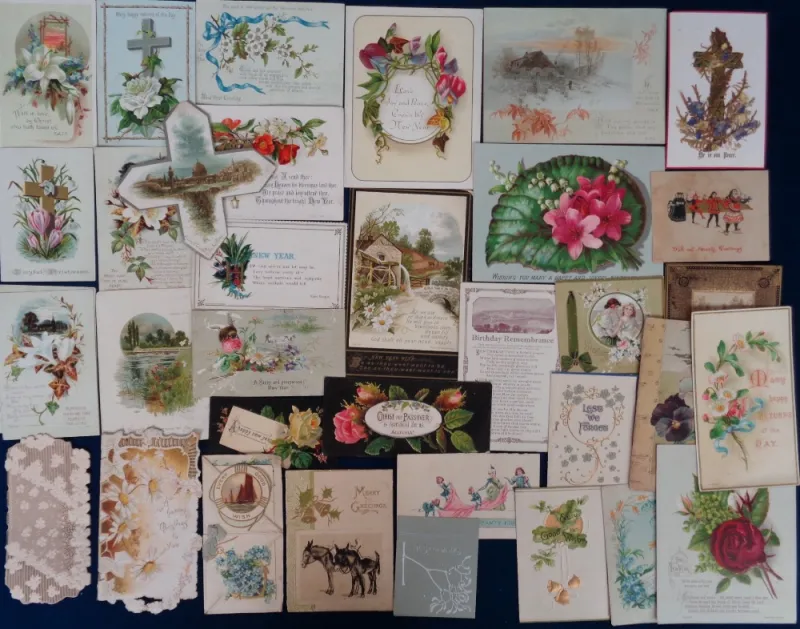
Photo: vintage Victorian greeting cards antique paper letters correspondence, via portal-images.azureedge.net
At some point in your life, you've stood in a greeting card aisle for longer than you'd like to admit, reading the same four versions of "Thinking of You" and trying to figure out which one sounds the least like it was written by a committee. Which, of course, it was. They all were.
And yet you buy one anyway. You sign your name at the bottom — sometimes adding a small personal note, as if to prove you were there — and you send it off. The recipient knows you didn't write the words. You know they know. Nobody says anything about it. The card gets displayed on a mantelpiece for a week and then quietly recycled.
It's a strange ritual. But it's one that Americans perform about 6.5 billion times a year, generating somewhere north of $7 billion in annual spending. The greeting card industry is enormous, durable, and — in the age of text messages and Instagram stories — somehow still growing.
To understand why, you have to go back to a specific problem that 19th-century British society had absolutely no idea how to handle.
The Victorian Silence Problem
The Victorians had an intricate, almost baroque relationship with death and grief. They had elaborate mourning rituals — specific clothing, specific periods of social withdrawal, specific rules about when you could return to normal life. What they didn't have was a comfortable language for expressing condolence.
Visiting a grieving family was fraught with social peril. Say too much and you were intrusive. Say too little and you were cold. Write a letter and you risked putting the wrong thing on paper permanently. The social expectation was to acknowledge loss, but the cultural vocabulary for doing so was genuinely underdeveloped — particularly across class lines, where the rules of formal address made even simple expressions of sympathy feel like navigating a minefield.
This wasn't just a death problem. It extended to illness, recovery, new babies, marriages, and the general category of "something significant happened in your life and I am supposed to respond to it." The middle class was expanding rapidly. People had wider social circles than their parents had. The number of occasions requiring an appropriate response was growing faster than anyone's ability to come up with one.
Somebody needed to solve this. And in England in the 1840s, a few somebodies did.
The Christmas Card Loophole
The first mass-produced greeting card is generally credited to Sir Henry Cole, a British civil servant who commissioned an illustrated card in 1843 as a way of dealing with the volume of Christmas correspondence he owed and had no time to write. The card — designed by artist John Callcott Horsley — showed a family celebrating, with panels on either side depicting acts of charity. It read: "A Merry Christmas and a Happy New Year to You."
Cole had about a thousand printed and sold the extras for a shilling each. The response was strong enough to suggest that other people had the same problem he did: the social obligation to communicate something warm and appropriate, combined with no particular gift for doing so.
The Christmas card spread quickly. By the 1860s, cheaper printing techniques had made mass production viable, and the British card industry was established. The sentiment-for-hire model — someone else writes the words, you attach your name — turned out to be extraordinarily appealing to a population that was increasingly expected to maintain broad social networks but had neither the time nor the vocabulary to do it personally.
How It Crossed the Atlantic
American entrepreneur Louis Prang gets most of the credit for bringing the greeting card to the United States at scale. Prang was a lithographer based in Boston who began producing Christmas cards in the early 1870s and, by the 1880s, was printing millions of them annually. He was meticulous about quality — his cards were genuinely beautiful objects, printed in vivid color at a time when that was technically impressive — and he understood that Americans would pay for something that helped them meet a social obligation gracefully.
Prang eventually lost market share to cheaper imported cards and stepped back from the business in the 1890s. But the infrastructure he helped build didn't disappear. It waited for the next wave.
That wave arrived with the founding of Hallmark in 1910. Joyce Hall — the founder, whose name the company bears — started selling postcards from a shoebox in a Kansas City YMCA room and built what would become the dominant force in American card culture. His timing was good. The postal system was becoming reliable and affordable. Literacy rates were rising. And Americans, like the Victorians before them, were accumulating social obligations faster than they could personally fulfill them.
The Obligation Economy
Here's the part nobody in the card industry will say out loud but everyone implicitly understands: the greeting card is not primarily a vehicle for personal expression. It's a social obligation management tool.
When you send a sympathy card, you are not really communicating a unique sentiment. You are signaling that you are the kind of person who sends sympathy cards. You are fulfilling a social contract. The recipient understands this. They appreciate it not because the words moved them, but because the act of sending — the effort, the stamp, the trip to the store — signals that you care enough to perform the ritual.
The industry figured this out early. That's why cards exist for categories of human experience that barely seem to warrant them: "Congratulations on Your New Job," "Sorry for Your Loss of a Pet," "Happy Administrative Professionals Day." Each new card category is really a newly codified social obligation — a new situation in which not sending a card can now be read as a failure of care.
Why We Still Buy Them
Every few years, someone writes a piece predicting the death of the greeting card. Email killed it. Then texting killed it. Then social media killed it. And yet Americans keep buying them.
The most convincing explanation isn't nostalgia. It's physicality. A card is an object. It can be held, displayed, kept in a drawer. It requires a decision — you have to go somewhere or click through something, choose, purchase, write something in it, and send it. That sequence of deliberate actions communicates something that a text message cannot, not because the words are better, but because the effort is legible.
The Victorians understood this intuitively, even if they never articulated it. They didn't need the words to be perfect. They needed proof that someone had tried.
That's still what a greeting card is, 180 years later. A piece of paper that says: I knew this mattered, and I did something about it. The words on the inside are almost beside the point.