The Keyboard Layout That Was Obsolete Before Your Grandparents Were Born — And Still Won't Die
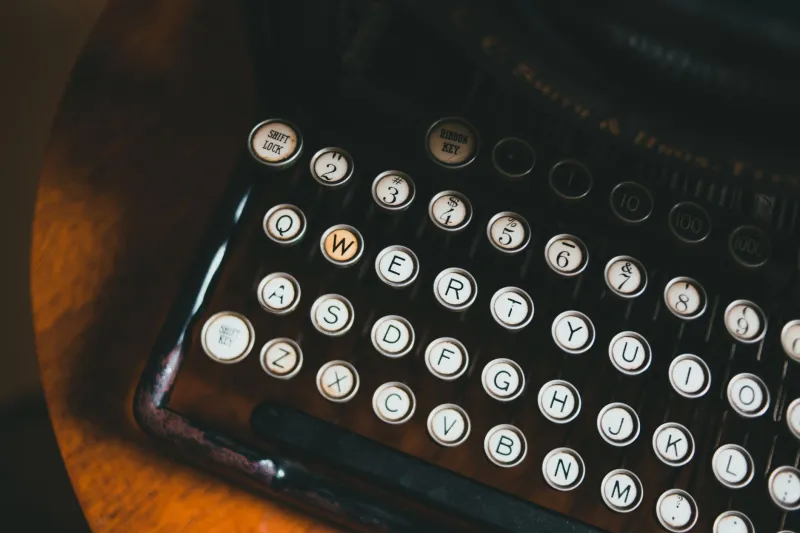
Look at the top row of your keyboard. Q-W-E-R-T-Y. Now ask yourself: why those letters, in that order?
It's not alphabetical. It's not arranged by frequency of use. It's not optimized for speed or comfort or any ergonomic principle that has ever been studied. The most commonly used letters in the English language — E, T, A, O, I, N — are scattered across three rows with what looks like deliberate inconvenience.
The answer, it turns out, is that QWERTY was designed to solve a problem that no longer exists. And the most fascinating part isn't that we built it that way. It's that we've never been able to stop using it.
The Mechanical Problem Nobody Talks About Anymore
In 1868, a Wisconsin newspaper editor and amateur inventor named Christopher Latham Sholes was tinkering with what would become the first commercially successful typewriter. The machine worked by pressing a key, which triggered a metal arm — called a typebar — to swing up and stamp a letter onto a ribbon pressed against paper. Simple enough.
The problem was that typists were fast. Faster than the machine could handle. When two nearby keys were struck in quick succession, their typebars would collide mid-swing and jam together, locking the mechanism and requiring the typist to manually free them. It was slow, frustrating, and happened constantly with common letter combinations.
Sholes's solution was clever in a very specific, mechanical way: separate the most commonly paired letters so their typebars were physically far apart. If E and R were on opposite sides of the keyboard, the arms wouldn't collide. It wasn't about typing speed. It was about preventing the machine from breaking itself.
The Remington Arms Company — yes, the gun manufacturer, which had pivoted into manufacturing after the Civil War — licensed Sholes's design in 1873 and began mass-producing it. The QWERTY layout shipped with every machine. By the 1880s, it was the standard.
The Problem Disappeared. The Layout Stayed.
By the early twentieth century, typewriter engineering had advanced significantly. The typebar jam problem had been solved through better mechanical design — springloaded returns, improved timing, sturdier construction. The original reason for QWERTY's strange arrangement had become irrelevant.
But by then, it didn't matter. Millions of typists had already trained their hands to the layout. Typing schools taught it. Businesses expected it. Remington's competitors, rather than introducing their own layouts, simply adopted QWERTY to avoid confusing buyers who had already learned to type. The layout had achieved what economists call a network effect: the more people who used it, the more valuable it became to use it, regardless of its actual merits.
In 1932, a University of Washington professor named August Dvorak introduced what he believed was a genuinely superior alternative. The Dvorak Simplified Keyboard placed the most common English letters on the home row — the middle row where your fingers rest naturally — and arranged them to maximize alternating hand use, reducing finger movement and fatigue. Studies he conducted showed significant speed improvements.
Almost nobody switched.
Every Replacement Failed
Dvorak spent decades promoting his keyboard. The US Navy ran a retraining program during World War II that showed promising results. A handful of speed-typing champions adopted it and broke records. None of it created lasting momentum.
The pattern repeated itself throughout the twentieth century. The Colemak layout, introduced in 2006, was designed to require fewer key changes from QWERTY than Dvorak while still dramatically improving efficiency. It has a devoted following online. It has not replaced anything.
Apple, Microsoft, and Google have all included alternative keyboard layout options in their operating systems for decades. They're buried in accessibility settings. Almost nobody uses them.
Even the shift to touchscreens — which should have been the perfect moment to redesign everything from scratch, since there were no physical keys to retool — resulted in virtual QWERTY keyboards on every smartphone. The layout survived its own obsolescence twice: once when the mechanical problem disappeared, and once when the physical keyboard itself disappeared.
The Economics of Being Stuck
Economists have a term for this: path dependence. It describes situations where the option you chose early in a process constrains every choice that comes after, even when better alternatives emerge. The initial decision creates infrastructure — physical, institutional, cognitive — that becomes increasingly expensive to dismantle.
Switching from QWERTY isn't just a matter of learning a new layout. It means retraining every typist. Reprinting every keyboard. Updating every piece of software that maps physical keys to functions. Rebuilding the entire institutional knowledge base of every school, office, and home that currently teaches and uses the existing standard.
The cost of switching isn't just personal inconvenience — it's a coordination problem. For Dvorak to win, nearly everyone would have to switch at roughly the same time. Because the value of a keyboard layout is largely determined by how many other people use the same one, any partial adoption creates an awkward in-between world where the switching cost is real and the benefit is theoretical.
It's the same reason the United States still uses Fahrenheit and the imperial measurement system while nearly every other country on earth uses metric. The technical argument for switching is overwhelming. The practical argument for switching is almost impossible to win.
A Perfect Fossil
There's something almost poetic about QWERTY's persistence. It was designed for a world of metal arms and ink ribbons. It survives in a world of touchscreens and voice recognition. It was never the best solution, even when it was the only solution. And yet here it is, on every device you own, exactly where Christopher Sholes left it in 1873.
The QWERTY keyboard is a fossil — a physical artifact of a problem that no longer exists, preserved in amber by the sheer weight of everyone who learned to use it. Every time you reach for the Q key, you're performing a motion designed to keep a nineteenth-century typebar from jamming.
The machine is long gone. The ghost of its limitations is still guiding your fingers.