The Ancient Shorthand That Quietly Became Democracy's Most Important Tool
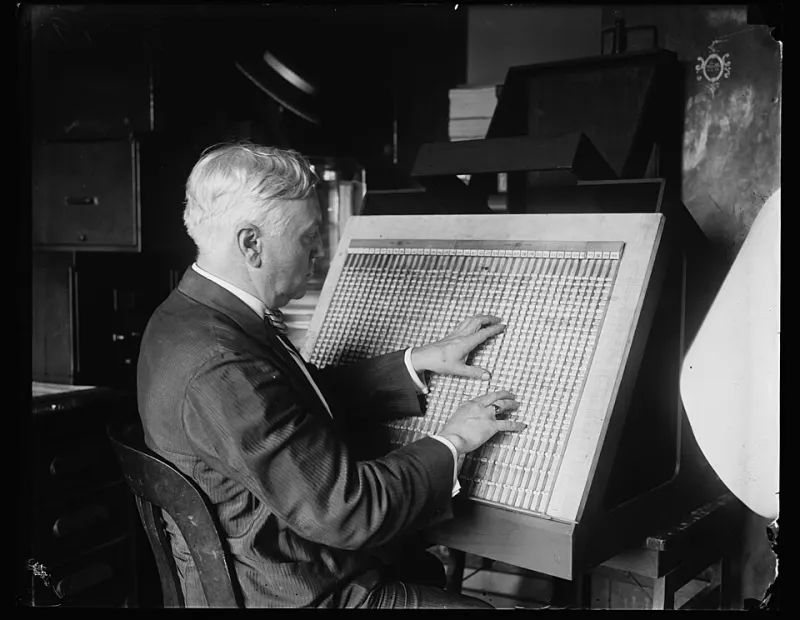
Photo: Harris & Ewing, photographer, Public domain, via Wikimedia Commons
The Ancient Shorthand That Quietly Became Democracy's Most Important Tool
In every American courtroom, tucked slightly to the side of the main action, sits a person that most people barely notice. They're not a lawyer, not a judge, not a witness. They don't speak. They don't object. They don't cross-examine anyone. They just sit there, fingers moving over a small machine with a keyboard that looks like nothing else in the room, producing a record that almost nobody in the gallery will ever read.
They are, in a very real sense, the reason due process exists in practice rather than just on paper.
Court reporters — stenographers — are so embedded in the American legal system that their presence registers as background furniture. But the technology they use, and the function they serve, has a history that stretches back more than two thousand years, passes through the courts of ancient Rome, the private notebooks of Renaissance scholars, and the chaotic early sessions of the U.S. Congress before arriving in its modern form. Trace it back far enough, and stenography isn't just a courtroom tool. It's one of the oldest information technologies in Western civilization.
Rome's Speed Problem
The origin of shorthand as a formal system begins, like so many things, with the Romans — specifically with a man named Marcus Tullius Tiro, a freed slave who served as personal secretary to the philosopher and statesman Cicero in the first century BCE.
 Photo: Marcus Tullius Tiro, via img.freepik.com
Tiro's problem was a familiar one: his employer talked faster than anyone could write in longhand Latin. Cicero was prolific, politically active, and constantly dictating. Tiro needed a way to keep up. His solution was a system of abbreviations and symbols — known as Tironian notes — that could represent common words, phrases, and grammatical structures with a single mark. It wasn't exactly shorthand in the modern sense, but the underlying logic was identical: replace slow, full-letter writing with fast, compact notation.
Tironian notes spread beyond Tiro's personal use. Roman senators used them to record debates. Monks used adapted versions to copy manuscripts during the medieval period. The ampersand — the & symbol still used today — is a direct descendant of Tiro's symbol for the Latin word et, meaning "and." Every time you type an email address or a business name with that character, you're using a 2,000-year-old piece of Roman shorthand.
But Tiro's system, however clever, was difficult to learn and essentially proprietary. It didn't scale into something universally teachable. That problem would take another sixteen centuries to solve.
The English Reinvention
In 1588, a British physician named Timothy Bright published a book called Characterie: An Arte of Shorte, Swifte, and Secrete Writing by Character. It was the first published shorthand system in English, and it was, by most accounts, genuinely difficult to use — a collection of arbitrary symbols with limited logical structure. But it established something important: the idea that fast writing could be systematized, taught, and spread.
Bright's work inspired a wave of competing shorthand systems over the next two centuries. Samuel Pepys, the famous English diarist, used a shorthand system to write his private journals — partly for speed, partly because the coded nature of shorthand provided a layer of privacy. There's some evidence that Shakespeare's plays were recorded in shorthand by audience members, producing the imperfect early texts that scholars still debate today.
The real breakthrough came in 1837, when Isaac Pitman, a British schoolteacher, published Stenographic Sound-Hand — a shorthand system based on phonetics rather than arbitrary symbols. Pitman's system was logical, learnable, and fast. It spread rapidly through Britain and, critically, across the Atlantic to the United States.
 Photo: Isaac Pitman, via i.pinimg.com
America's Accuracy Problem
By the mid-19th century, the young American legal and legislative system had a problem that was growing more urgent with every passing year: no reliable method existed for creating verbatim records of what was actually said in courtrooms and legislative chambers.
Judges took their own notes. Lawyers took their own notes. Witnesses' statements were summarized rather than transcribed. The result was a system where the official record of a legal proceeding was, at best, an approximation — filtered through the handwriting speed and personal interpretation of whoever happened to be holding the pen. Appeals were difficult. Inconsistencies were rampant. The gap between what was said and what was recorded created genuine injustice.
Pitman's phonetic shorthand arrived at exactly the moment this problem was becoming impossible to ignore. Trained stenographers could record speech in real time, producing a phonetic transcript that could later be translated into full written text. The accuracy wasn't perfect, but it was orders of magnitude better than anything that had existed before.
Court reporting as a formal profession began taking shape in the United States in the 1860s and 1870s. The federal courts were early adopters. State courts followed. By the end of the 19th century, a verbatim transcript — produced by a trained stenographer — was becoming the expected standard of legal documentation rather than a luxury reserved for high-profile cases.
The Machine That Changed Everything
The stenotype machine — the strange, chord-based keyboard that modern court reporters use — arrived in the early 20th century, developed by Ward Stone Ireland around 1911. Instead of recording individual letters, the stenotype allows reporters to press multiple keys simultaneously, representing entire syllables or common words with a single chord. A skilled operator can sustain speeds of 225 words per minute or more — comfortably outpacing even the fastest speakers.
 Photo: Ward Stone Ireland, via thumbs.dreamstime.com
The machine transformed court reporting from a demanding skill into a near-superhuman one. It also made the profession more consistent and the transcripts more reliable. By the mid-20th century, the stenotype had become standard equipment in American courtrooms, and court reporters had become essential officers of the court — legally responsible for the accuracy of the official record.
That responsibility is not ceremonial. The transcript a court reporter produces is the document that appeals courts review. It's the record that determines whether a conviction stands or falls, whether a contract dispute was correctly adjudicated, whether a witness actually said what someone claims they said. In a legal system built on the principle that facts matter, the court reporter is the person who establishes what the facts were.
The Invisible Guarantee
What's striking about stenography's role in American democracy is how thoroughly invisible it is to most people. Jurors don't think about it. Defendants rarely think about it. Even lawyers, who depend on transcripts constantly, tend to treat court reporters as part of the courtroom furniture rather than as essential participants in the legal process.
But the verbatim record is what separates a legitimate legal proceeding from an arbitrary one. Without it, due process is a principle without a mechanism. With it, every word spoken under oath is preserved, challengeable, and permanent.
Tiro couldn't have imagined any of this when he was trying to keep up with Cicero's dictation in the first century BCE. He was just trying to solve a speed problem. Two thousand years later, the solution he pioneered is still running — quietly, in the corner of every American courtroom, fingers moving over a machine that most people will never look at twice.