The Clergyman Who Grabbed the Wrong Bark — And Set Off a Billion-Dollar Chain Reaction
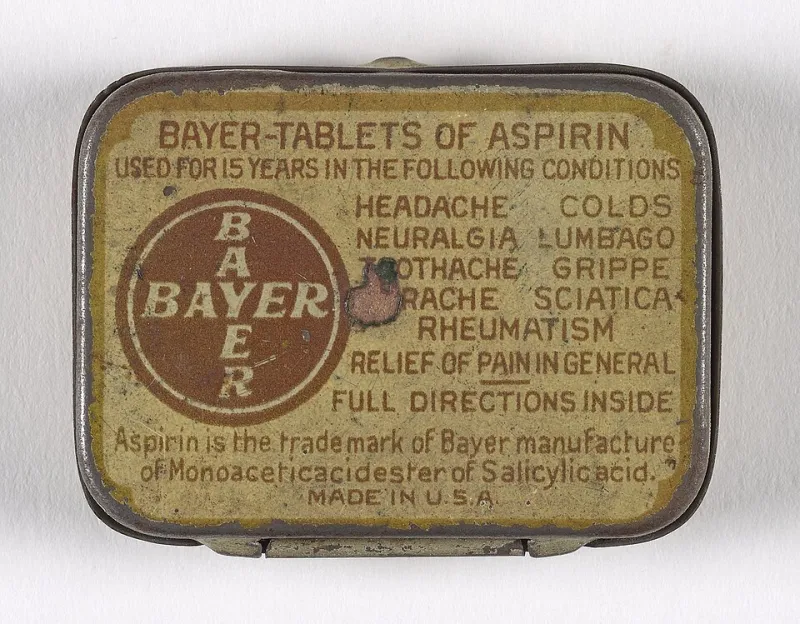
Photo: Bayer Company, Inc, Public domain, via Wikimedia Commons
The aspirin tablet is so ordinary it barely registers. It's in the medicine cabinet, the purse, the glove compartment, the office desk drawer. Americans consume somewhere around 50 billion of them every year. It treats headaches, reduces fevers, thins the blood, and may lower the risk of heart attacks. It costs almost nothing.
But the story of how that small white tablet came to exist is genuinely strange — a winding path through botanical misunderstanding, accidental chemistry, corporate maneuvering, and two world wars. It starts, of all places, with a vicar standing next to a river in rural England.
The Reverend's Experiment
In 1763, Reverend Edward Stone of Chipping Norton, Oxfordshire, wrote a letter to the Royal Society of London describing an experiment he'd been conducting for five years. He had been chewing and boiling the bark of white willow trees and administering the bitter preparation to people suffering from fevers and agues — what we'd now call malaria-adjacent conditions.
 Photo: Chipping Norton, via c8.alamy.com
 Photo: Reverend Edward Stone, via alchetron.com
It worked. Reliably enough that he felt confident reporting it to Britain's premier scientific body.
His reasoning was almost entirely wrong, though. Stone wasn't guided by any understanding of chemistry or plant biology. He was operating on a folk principle called the Doctrine of Signatures — a medieval idea suggesting that nature places cures near causes. Willow trees grew in damp, marshy ground. Damp, marshy ground caused fevers. Therefore, he reasoned, willow bark might treat fevers.
The logic was circular and the botanical theory was nonsense. But the result was real. Willow bark contains salicin, a compound the human body converts into salicylic acid — a natural anti-inflammatory and fever reducer. Stone had stumbled onto something significant while looking for something else entirely.
A Century of Chemistry
The discovery sat in the literature for decades, acknowledged but not fully understood. In the early 19th century, European chemists began isolating and identifying the active compounds in willow bark more precisely. By 1828, a German pharmacist named Johann Buchner had extracted a yellowish crystalline substance from willow bark and named it salicin. A few years later, French chemist Henri Leroux refined the extraction process and Italian chemist Raffaele Piria broke salicin down further into salicylic acid.
Salicylic acid worked well as a pain reliever and fever reducer. It also caused significant stomach irritation, sometimes severe enough to be worse than the original complaint. Patients taking it for rheumatism or chronic pain often found themselves trading joint pain for stomach pain. It was effective but barely tolerable.
The search for a gentler version occupied chemists throughout the mid-19th century. Several attempts were made to modify the compound's structure without destroying its therapeutic effect. Most failed or produced worse side effects.
The Accidental Synthesis
In 1897, a young chemist named Felix Hoffmann, working at the Bayer company in Germany, successfully synthesized acetylsalicylic acid — a chemically modified form of salicylic acid that retained the pain-relieving properties while being significantly easier on the stomach.
Here's where the story gets contested. For most of the 20th century, Hoffmann received full credit for the discovery. But another Bayer chemist, Arthur Eichengrün, later claimed that he had directed the project and that Hoffmann had essentially followed his instructions — and that his own contributions had been erased from the record, at least partly because he was Jewish and the Nazi-era rewriting of German industrial history had little interest in preserving his role.
Historians still debate the full picture. What isn't disputed is that Bayer patented the compound in 1899 under the trade name Aspirin — derived from a (for acetyl) and spirin (from Spiraea, a plant genus that also contains salicylates). The name stuck.
War, Seizure, and the American Market
Aspirin became one of Bayer's most valuable products almost immediately. It was sold in powder form initially, then as a tablet — a format that made it portable, dosable, and easy to distribute. By the early 1900s, it was being used across Europe and North America for everything from headaches to arthritis to the common cold.
Then World War I arrived and changed everything.
When the US entered the war in 1917, German-owned patents were seized under the Trading with the Enemy Act. Bayer's US patent on aspirin was auctioned off in 1918 as enemy property. The winning bidder was Sterling Products, an American company, which paid roughly $5.3 million for it — a significant sum at the time.
The seizure effectively broke Bayer's monopoly and opened the American market to generic aspirin production. Prices dropped. Availability expanded. And then the 1918 influenza pandemic hit, killing an estimated 50 to 100 million people worldwide. Aspirin was one of the few tools doctors had for managing symptoms. Demand exploded.
From Medicine Cabinet to Cultural Fixture
By the 1920s, aspirin had moved from pharmacy counter to household staple. Bayer — which had re-established itself in the US after the war — ran aggressive advertising campaigns positioning the drug as the answer to headaches, colds, muscle pain, and fatigue. The white tablet became as ordinary as a glass of water.
Decades later, research would reveal additional properties that nobody had anticipated. In the 1970s, British pharmacologist John Vane demonstrated how aspirin inhibits prostaglandins — compounds involved in inflammation and pain signaling — work that earned him a Nobel Prize in 1982. Studies in the 1980s and 1990s began linking low-dose daily aspirin to reduced risk of heart attacks and strokes, adding an entirely new category of users to an already enormous market.
 Photo: John Vane, via image.slidesharecdn.com
The Tablet That Outlasted Everything
Today, aspirin sits in an unusual position in American medicine — old enough to be off-patent and sold generically for pennies, yet still recommended by cardiologists, still studied by researchers, still reaching for in moments of ordinary discomfort. It has outlasted dozens of newer drugs that were supposed to replace it.
Trace it back and you find a country vicar with a flawed theory standing next to a river, boiling bark because he thought geography was medicine. He was wrong about almost everything except the result. And that result — filtered through a century of chemistry, a world war, a patent auction, and a pandemic — became the little white tablet that lives in virtually every American home.
Some discoveries are elegant and intentional. This one was neither. It was better than that — it was an accident that kept paying off for three hundred years.