The Sandwich That Soldiers Spit Out — And Kids Couldn't Stop Eating
The Sandwich That Soldiers Spit Out — And Kids Couldn't Stop Eating
Ask any American to name the most comforting food they can think of, and a remarkable number of them will say the same thing: peanut butter and jelly on white bread. No garnish. No sides. Just that. It's the kind of answer that surprises nobody — which is exactly what makes it strange. Because the sandwich that came to define American childhood wasn't invented by a loving parent or a clever school cafeteria worker. It came out of a military supply chain, was largely disliked by the soldiers who received it, and somehow became one of the most emotionally loaded foods in the history of this country.
Tracing it back means going somewhere most people wouldn't expect: a World War II ration kit.
The Army's Unlikely Contribution to Lunch
By the early 1940s, the U.S. military had a serious logistical challenge. Soldiers in the field needed food that was calorie-dense, shelf-stable, and easy to eat without equipment. Peanut butter, already a product with a growing commercial presence, checked most of those boxes. It was cheap, high in protein, and didn't spoil easily. The Army began including it in field rations alongside crackers and canned goods.
At some point — and the exact origin is disputed — soldiers started pairing their peanut butter with the grape jelly or jam that also appeared in their rations. The combination wasn't revolutionary. It wasn't even particularly popular. Many troops found it cloying, repetitive, and nothing they'd choose to eat back home. But it traveled. It kept. And it delivered calories when calories were what kept you moving.
What happened next is the part that most food historians find genuinely fascinating: the soldiers came home.
Sliced Bread Made It Possible. Postwar America Made It Inevitable.
When millions of young men returned from Europe and the Pacific in the mid-1940s, they brought food memories with them — including, apparently, a muscle-memory familiarity with peanut butter and jelly. That might have meant nothing if the American food landscape hadn't been shifting in exactly the right direction at exactly the right moment.
Wonder Bread and its competitors had already normalized pre-sliced white bread. Brands like Skippy and Peter Pan had been refining mass-produced peanut butter since the 1930s, making it smoother, more spreadable, and far more palatable than the gritty early versions. And commercial jelly — particularly Smucker's grape — was becoming a genuine pantry staple rather than a seasonal preserve.
All three products were now affordable, widely distributed, and designed for speed. Put them together, and you had a lunch that a parent could assemble in under two minutes, that a child could make themselves, that cost almost nothing, and that kept well in a paper bag all morning. For postwar America — optimistic, busy, increasingly suburban — it was almost too convenient to ignore.
School cafeterias noticed. Mothers noticed. And then, critically, the children themselves noticed.
Why Kids Claimed It as Their Own
There's a reason the PB&J became specifically a children's food rather than a family staple eaten by everyone at every meal. Adults, particularly those who'd grown up before the war, still associated lunch with something more substantial — a hot meal, a proper sandwich with meat and cheese. The peanut butter and jelly sandwich was fast food before fast food existed, and for a generation of parents who'd survived the Depression and a world war, fast wasn't necessarily a compliment.
But for kids growing up in the 1950s and 1960s, the sandwich carried no such baggage. It was theirs. Sweet, simple, and entirely predictable — which, if you've ever spent time around a seven-year-old, is a profound selling point. The texture contrast between the sticky peanut butter and the slippery jelly, all held together by soft white bread, hit a sensory combination that younger palates responded to almost universally.
By the time those kids became parents themselves, packing the same sandwich for their own children felt less like a convenience and more like a tradition. And traditions, once embedded in childhood memory, become almost impossible to dislodge.
The Nostalgia Engine
What's remarkable about the PB&J isn't just how widely it spread — it's how deeply it embedded itself in American emotional life. Food researchers and cultural historians have noted that the sandwich functions less like a meal and more like a memory trigger. The smell of peanut butter alone is enough to pull many Americans straight back to a specific kitchen, a specific lunchbox, a specific age.
That kind of emotional resonance doesn't happen by accident. It happens when a food becomes tied to a universal experience — and in postwar America, the school lunch was about as universal as it got. Rich kids ate it. Poor kids ate it. Kids in rural Kansas and kids in urban Detroit ate it. The PB&J was one of the few foods that genuinely crossed class lines, not because it was aspirational, but because it was accessible.
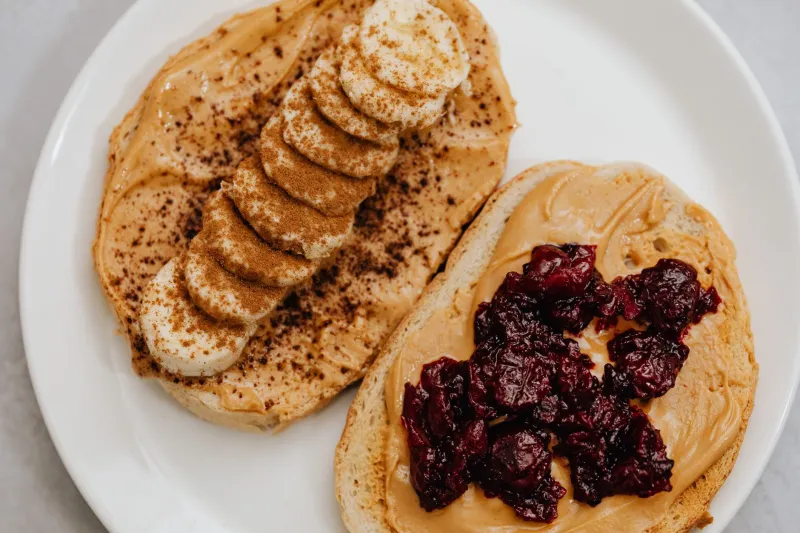
Today, Americans consume roughly 2.5 billion pounds of peanut butter annually, and surveys consistently show the sandwich remains one of the most recognized lunch items in the country. Specialty versions — almond butter and honey, sunflower butter for allergy-sensitive classrooms — have multiplied around it. But the original combination, grape jelly on creamy peanut butter on white bread, hasn't changed much since the 1950s.
From Ration to Ritual
The soldiers who first combined peanut butter and jelly in the field probably would have laughed at the idea that they were creating an American institution. To them, it was a ration. Something you ate because it was there.
But that's often how the most durable food traditions begin — not with intention, but with circumstance. The right ingredients, available at the right moment, eaten by the right generation at an impressionable age. The military supplied the combination. Postwar prosperity supplied the infrastructure. And American children supplied the loyalty that turned a wartime convenience into a cultural touchstone.
You can trace it all the way back. But at some point, the origin stops mattering — because the sandwich stopped being about where it came from and became entirely about where it takes you.